
The Lens - Surveillance - The Who and The How
New Orleans launched its video surveillance network in 2017. Since then, a small group of engaged residents and activists has been trying to figure out exactly what it’s capable of and how it works.
It has not been easy.
The city has actively fought to keep details of its surveillance apparatus out of public view. But it’s only had to do that when people knew what to ask about. At times, officials simply added new surveillance equipment under the radar, with no public announcement.
But for all the muddiness, the city did draw one clear line in the sand early into the camera program: Facial recognition analysis would not be part of its arsenal.
The New Orleans Police Department responded to public records requests and media inquiries by saying the department “does not employ facial recognition software.” The restriction is even written in bold on the city’s website and included in the privacy policy for the Real Time Crime Center — the central monitoring hub for the city’s 975 live camera feeds.
It was a rare piece of clarity. Except it wasn’t true.
In November 2020, the city admitted that NOPD detectives had been using facial recognition software since at least 2018. The city wasn’t using its own software. It was outsourcing facial recognition analysis to the xxxxxx, a xxxxx.
It wasn’t the first time the city of New Orleans had been accused of lying to the public about a controversial surveillance tool.
In 2018, The Verge revealed that the NOPD had been quietly using an advanced data-mining software with predictive policing analytics from Palantir, a software juggernaut founded by billionaire Peter Thiel with seed money from the CIA. The tool was used to predict which New Orleans residents were at highest risk of being involved in a gun crime and compile a list of the one percent of the city’s population with the highest perceived risk. It also allowed one NOPD analyst to rank residents on a “gang-member scorecard.”
“The status quo is that the government is really free to acquire, deploy, expand existing surveillance technology outside of public view and without public input and without oversight,” said Chris Kaiser, the advocacy director for the ACLU of Louisiana, at a July New Orleans City Council hearing. “Often, as a result, we really don't know what's out there.”
Even getting basic information about the surveillance network can be an exhausting exercise for privacy advocates.
In 2019, Laura Bixby, an attorney for the Orleans Public Defenders office, wanted to get a map of the city’s crime cameras. The cameras were visible to anyone, but the city moved them periodically. Bixby, who had once been surprised to find, during trial prep, that one of her clients was captured on a city surveillance camera, thought that their locations should be readily available to her office and the public. The city refused her requests. So she sued, represented by the ACLU of Louisiana.
The city foughtended up fighting the lawsuit all the way up to the Louisiana Supreme Court before it was finally forced to turn over the locations in 2020, years after the cameras first went up.
“The fact that we had to sue to get a map of publicly visible cameras I think just illustrates the kind of ridiculousness of the city claiming it has any type of transparency when it comes to surveillance,” said Bruce Hamilton, Senior Staff Attorney for the ACLU of Louisiana. “If transparency was anything more than just lip service, the city would have just said, ‘Here's the map.’ We shouldn't have had to fight for it.”
Beyond the maps, the city has also restricted access to footage. The cameras are recording across New Orleans all the time, but most of that footage is unavailable unless it’s been flagged for archival by law enforcement or other city agencies, a policy that appears to violate state law.
To Hamilton, the city’s record points to a clear conclusion: The public can’t trust the city to willingly and accurately inform them about the tools it uses to spy on them.
“They don't deserve our trust,” Hamilton said.
Hamilton is part of the Eye on Surveillance coalition — a local New Orleans anti-surveillance and privacy advocacy group. Group members believe that the power and potential risks of mass data collection call for real transparency: community engagement, active releases of the city’s surveillance tech inventory, centralized oversight and legislation designed to keep the city in check. Little — arguably none — of that has happened so far.
Surveillance systems similar to New Orleans’ are in use across the US, from major cities like New York, Detroit and Chicago to smaller cities like New Orleans or Birmingham, Alabama. These systems are even trickling down to small towns with populations under 1,000. And intelligence sharing between local, state and federal governments is giving local police departments access to information and tools they’ve never had before.
“Some of those traditional checks and balances as far as budgeting are being circumvented and police departments are building huge arsenals of surveillance technology without any type of public engagement,” said Nathan Sheard, the Associate Director of Community Organizing for the Electronic Frontier Foundation. “And police departments have been extremely reluctant to disclose information about the type of surveillance technology that they're using.”
Albert Fox Cahn, a New York-based privacy advocate, founded the Surveillance Technology Oversight Project, or STOP, in 2019 specifically to address the explosion of local and state surveillance systems in recent years. While Cahn is alarmed at the rapid growth in mass surveillance, he’s encouraged by another, parallel trend — communities organizing and forcing their local governments to set surveillance restrictions and guard rails.
“The intersection of technology and local government activity is one of the most potent threats to civil rights, and also one of the most potent opportunities for civil rights reform,” Cahn said. "This is the inflection point. We're at the moment where this technology is becoming so prominent, it's becoming so cheap, it's becoming such a central part of how we govern our societies that this is the moment we get to choose which path we go down.”
Need Subtitle permalink
Mayor LaToya Cantrell’s office denied multiple interview requests for this project and ignored many of The Lens’ emailed questions. But a written statement from her office pushed back on allegations that the city lacked transparency. The statement said that the Real Time Crime Center “is governed by a strict policy” and that “access is restricted and monitored.”
“In the interest of protecting privacy rights and ensuring that video is utilized solely for public safety purposes, unarchived video is only available for release through a formal judicial process,” the statement said. "The Crime Center has hosted many community groups for tours and has attended dozens of community meetings to provide information on the public safety camera program and to answer frequently asked questions. A map of camera locations is available on the website, along with a form for residents to submit camera location requests."
Some agree with the city that existing boundaries and checks and balances are enough to keep the tools in check.
Rafeal Goyeneche, a former prosecutor and president of the Metropolitan Crime Commission, said that while he agreed that there needs to be more rules and regulations around this technology, those regulatory mechanisms are already in place in the form of internal police policies and the court system. Those have been strengthened, he said, as a result of recent public demands for police reform.
“I think that with everything that's been going on is making law enforcement realize that they need to do a better job of memorializing how they're going to use all of this technology, all the rules and regulations that apply to it,” Goyeneche said. “ So now, you're starting to see extensive guidelines addressing the use of all technology become a more common thing.”
But not everyone has the same faith that the police will make sound surveillance policies and stick to them.
“The police department has established itself as being untrustworthy,” said Ursula Price, who is this. “We're just equipping the same group of people and the same institutions with even more weaponry.”
Rather than relying on federal courts and internal police policies, some communities in recent years have started instituting local solutions and accountability.
In the last decade, and especially within the last few years, communities across the US have been organizing against the surveillance sprawl and getting their City Councils to pass ordinances to provide oversight, regulations and outright bans on local surveillance usage. In 2016, the ACLU launched its Community Control Over Police Surveillance, or CCOPS, campaign and created a template ordinance for local City Councils that creates three central requirements to local surveillance usage: City Council review and approval of existing surveillance tech, a process for City Council approval of future tech and annual reporting requirements.
“Regulatory efforts are starting to catch up, but we were caught flat-footed,” said Tracy Rosenberg, an advocate with Privacy Oakland, a what based in the California city. “We're all making it up as we go along. The anti-surveillance movement as it is is maybe a decade old at best. So these are very new challenges we're facing.”
Oakland was one of the first cities to pass a CCOPS laws. According to the ACLU, at least 19 cities have passed some sort of CCOPS law since 2016, including Oakland; Nashville, Tennessee; Madison, Wisconsin; New York City and Pittsburgh.
“The biggest win of the framework, I think, that it brings everything out into the open,” said Brian Hofer, XXXX. “There's no more secret use of technology. There's no more secret policies or policies that were unilaterally written by the police with no community input. That dynamic has been turned on its head.”
[Something about how he said you don’t have to be antifa to want community oversight… things are coming down the pipeline that we need to talk about. Everyone has a line in the sand when it comes to privacy.]
“We can't regulate or prohibit technologies that we don’t know exist, that we don’t know our police department might be using,” Hofer said. “You can determine yourself in each community where to draw the line. It's up to the residents in that city to determine what they think is appropriate and not appropriate.”
need subtitle permalink
Goyeneche said new technology and software used by the police are just enhanced versions of what they’ve always done. He likened facial recognition to broadcasting a suspect photo and asking for citizen tips, both of which come with the risk of misidentification and racial bias.
“The technology is only a tool,” he said. “It doesn't mean that anyone's rights are being violated. It doesn’t mean the police are engaging in anything covert or constitutionally invalid.”
Local police have long monitored public spaces — standing on a street corner, staking out a house or following a suspect through public streets. And they have long used data on residents, like arrest records and DNA, to solve cases.
But Dave Maass, the head of investigations for the Electronic Frontier Foundation, argues that the technology at the fingertips of local law enforcement today isn’t just augmenting existing practices, it’s changing the nature of government surveillance altogether.
“If you look 20, 30, 40 years ago, when we're talking about surveillance, we're talking about a dude sitting in his car with binoculars looking at a particular person for a particular investigation,” Maass said.
“We look at where we are now, we're talking about the advent of technologies that are collecting data on everyone all the time, regardless of whether you're suspected of being involved in a crime.”
“These are fundamentally different things,” he said.
In 2017, New Orleans began deploying mass amounts of surveillance hardware. The number of police cameras and license plate readers in New Orleans has steadily increased every year since.
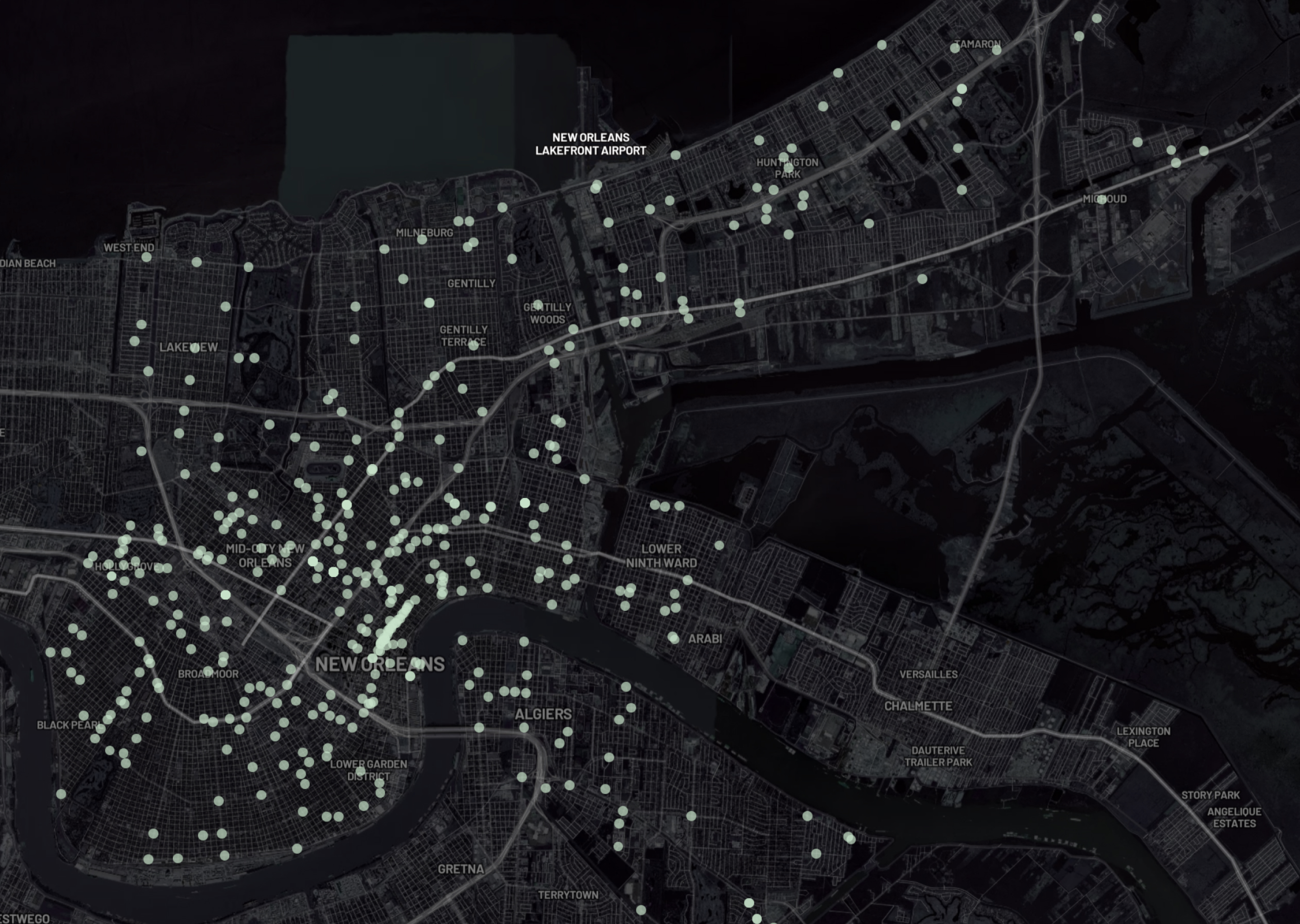
As of January 2021, the city had access to live video footage from 975 cameras. The city only directly owns 555 cameras, which are plotted on the map below.
The city has refused to release the locations of the remaining 420 because they aren’t owned by the city itself. These cameras are privately owned, attached to homes and businesses and connected to the RTCC through a program called SafeCam Platinum.
But the NOPD and the Real Time Crime Center have access to other cameras, whose locations are unknown. These cameras are license plate readers, body cameras, and dashboard cameras.
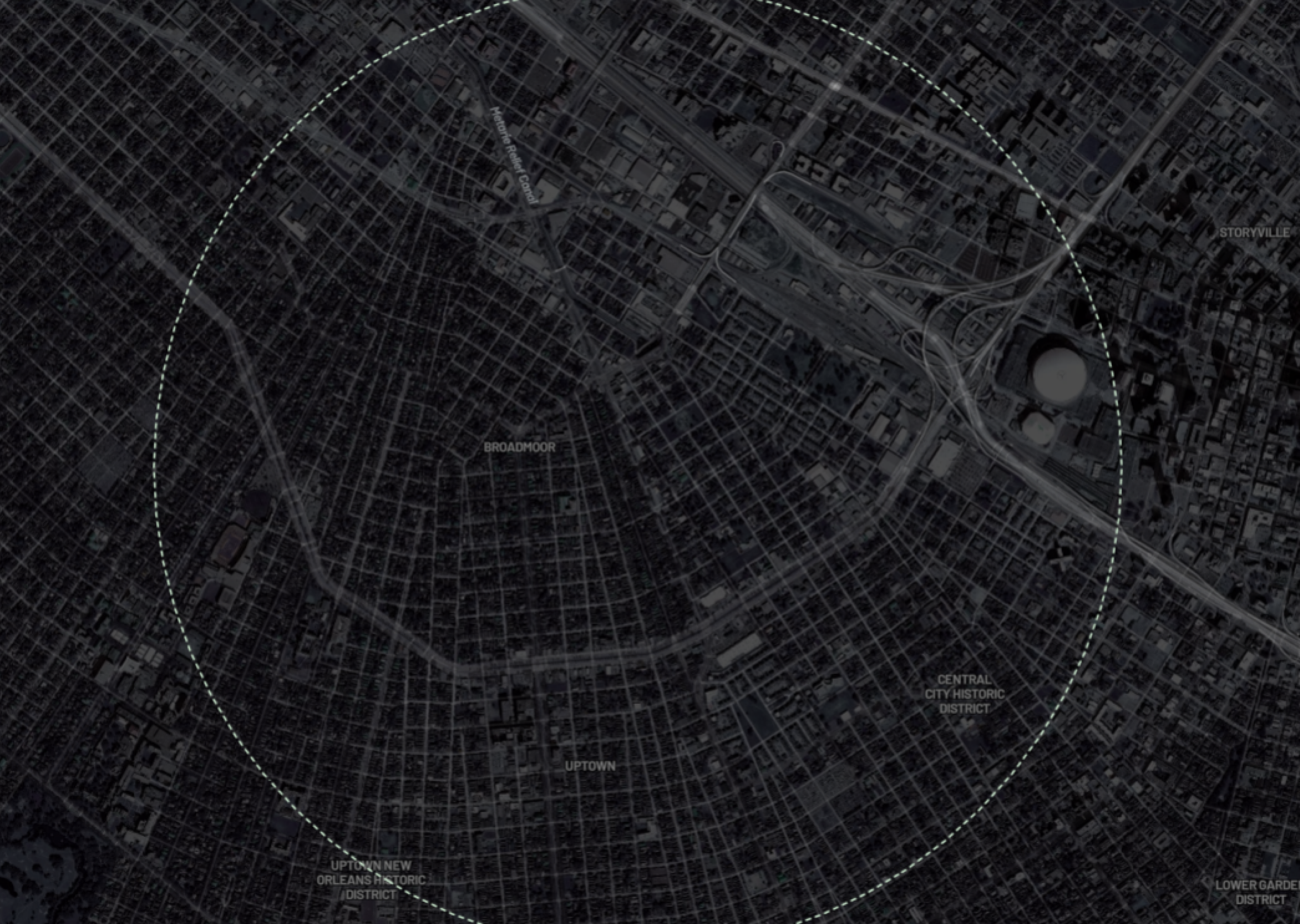
The city has refused to release a map of its fixed automated license plate readers. There is no fixed location for the NOPD’s 39 vehicle mounted license plate readers, 826 dash cameras or its hundreds of body cameras.
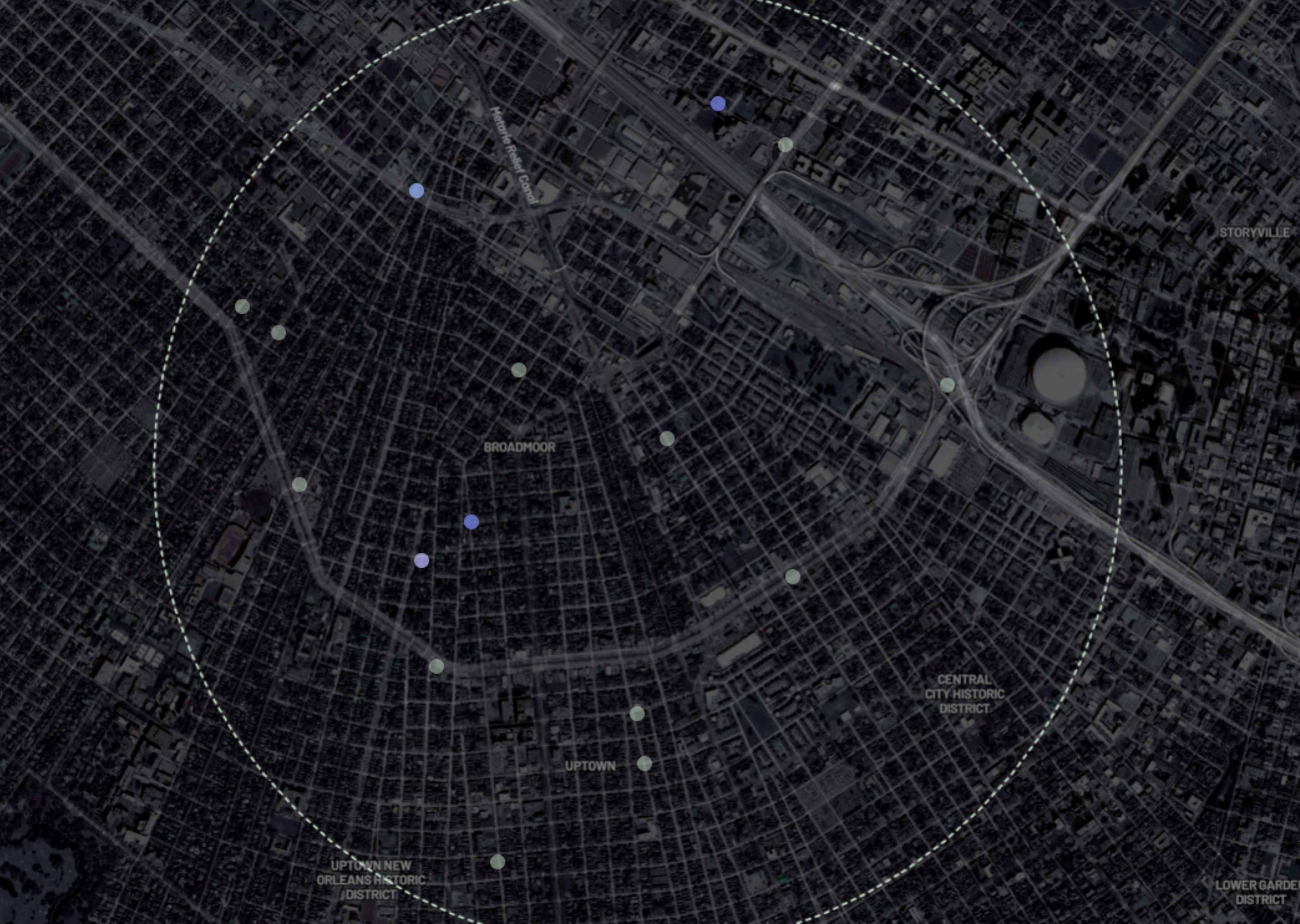
The majority of the city’s surveillance hardware is unmapped or constantly moving.
While the hardware is pervasive, the real power of New Orleans’ surveillance system is on the other side of the camera — the advanced analytic software that automatically mines, organizes and analyzes massive amounts of data.
“What we have now is algorithms that are watching all of the cameras all of the time, indexing everything in those cameras and then storing that potentially indefinitely,” Maass said.
When the city’s system went online in 2017, it used this kind of algorithm through software called BriefCam.
“BriefCam’s breakthrough technology detects, tracks, extracts and identifies people and objects from video, including; men, women, children, clothing, bags, vehicles, animals, size, color, speed, path, direction, dwell time, and more,” said a BriefCam press release announcing its work with the New Orleans Real Time Crime Center.
Once everything is broken down and cataloged, officers and automated systems can easily comb through months of footage in just seconds.
This type of software is also applied to body-worn cameras, adopted by the New Orleans Police Department since 2014 as an accountability measure. The Orleans Parish District Attorney’s Office started using software in 2016 to mine and catalog audio and video captured by body-worn cameras. The company announced its business with the New Orleans DA in a 2016 press release.
“It makes video completely searchable. The software creates an audio transcript and record of faces and text in each video through an automated system, which means an officer or investigator can type in a person's name or keywords like drugs and search for when and where it was spoken in the video.”
Cahn argues that while the public generally understands the basic privacy implications of a security camera, there is much less understanding of the software behind it.
“We definitely see the public understanding around these technologies is a decade behind for software where it is for hardware, and a decade behind algorithmic systems where it is for software. So it really is a huge gap,” Cahn said. “Part of why the surveillance state has been able to proliferate the way it has in recent years and decades is because of the technical learning curve, the legalistic learning curve, the barriers for much of the public to fully understand how these systems work.”
Surveillance operations that once required herculean efforts from teams of investigators now take just minutes with a click of a button. And not just for video footage. Similar analytics programs are also used on the massive amounts of data that the police have access to, like jail phone call logs, arrest records, incident reports, interview cards and parole and probation records.
Just like with the camera footage, the data by itself doesn’t always tell much of a story. But when you start to organize it, to piece it all together, it can paint a detailed portrait of someone’s life.
“That's where this ‘mosaic theory’ comes into play,” said Brian Hofer, the chair of the Oakland Privacy Advisory Commission. “The individual privacy impact from a single data point, probably low, maybe even zero.”
But, Hofer said, when you start to connect the dots and combine all that data using automated software, the it tells a story. He pointed to a 2013 peer-reviewed study in Scientific Reports that found that 95 percent of people could be identified based on just four geo-spatial data points — meaning a location, data and time.
“We're creatures of habit,” Hofer said. “We drive to work the same way. We drive to school the same way.”
“If you think about the volume of information that cities collect, which can include public health data, tickets and citations, educational records, voting records, the potential for what we call data fusion is kind of extensive,” said Tracy Rosenberg, an anti-surveillance activist with Privacy Oakland. “Certainly the pitch of the surveillance vendors has been we're going to let you get more information, but more importantly we're going to let you integrate it, we're going to take it out of silos, we're going to make the information work together, we're going to put it in one place. That is definitely surveillance nirvana.”
Smart cities permalink
A major turning point in the Eye on Surveillance fight occurred during one of the last City Council meetings before coronavirus lockdowns, when the council’s Smart and Sustainable Cities Committee was considering a seemingly innocuous program to install new street lights.
The city of New Orleans had been growing its surveillance and data collection capabilities for more than two years with little pushback from members of the New Orleans City Council when, in early 2020, a seemingly innocuous proposal about streetlights came before the council’s Smart and Sustainable Cities Committee.
The “Smart Cities Pilot” program, designed by Mayor LaToya Cantrell and funded with $3.2 million from the local utility company Entergy New Orleans, would have resulted in the installation of 146 “smart street lights.” Along with weather monitoring and Wi-Fi, the cameras would come equipped with video and audio recording.
The cameras weren’t primarily for police use, city officials said, and would be mainly used to study traffic patterns. But the footage would be made available to the Real-Time Crime Center.
Members of Eye on Surveillance were caught off-guard by the smart street light proposal, they told The Lens at the time.
“We’ve reached out to the city and said we want to be part of all the different conversations around surveillance,” said Theo Thompson, an organizer with Eye on Surveillance.
A lot of this stuff is happening without the community knowing what’s going on. You wake up and there’s a new camera on your block.”
For Thompson and other anti-surveillance organizers, the proposal highlighted just how widespread surveillance technology is becoming, and how difficult it is for the public to consent or reject new surveillance projects.
New Orleans’ surveillance network is a decentralized set of tools maintained by disparate city departments and agencies. There is no central oversight body for all that technology, no single venue where the public can go to give input on privacy issues. And advocates say it is nearly impossible to keep track of it all, especially with programs that, on their face, don’t seem to have surveillance implications.
“I guarantee that instead of saying they were having a meeting about smart cities, they said they were having a meeting about adding 146 more cameras, a lot more people would attend,” Marvin Arnold, another organizer with Eye on Surveillance, told The Lens last year.
[In San Diego, at the same time, the same technology sparked a backlash, and now the city is moving toward to regulatory regime similar to Oakland…. And now it was sparking something in New ORleans]
In a somewhat surprising turn, then-Councilman Jason Williams — who sponsored the measure to approve the deal on Cantrell’s behalf — decided to put the smart cities pilot on hold. At the time, Williams was running for Orleans Parish District Attorney. He had a background as a defense attorney, and he was trying to distinguish himself as the most progressive candidate for the seat, which had been occupied for decades by traditional, tough-on-crime prosecutors.
He told The Lens in a recent interview that discussions with Eye on Surveillance members made him realize “how pervasive this technology can be in every facet of our lives without us actually having an intelligent conversation about whether or not we want all of this to happen.”
“Through this process, meeting with the community and doing research myself, it became abundantly clear that this was one of those places where technology was moving at the speed of light but electeds and government were moving at a snail's pace in terms of creating policy around it,” Williams said.
At the committee meeting in March 2020 — one of the last in-person council meetings before coronavirus lockdowns began — Williams said that before moving ahead with the pilot, he would first work with Eye on Surveillance to pass a surveillance regulation ordinance based on the CCOPS model.
“We spent a lot of time trying to figure out what the national and international norms around this were,” said Arnold, one of the lead organizers with Eye on Surveillance.
Eye on Surveillance worked with advocates from around the country including Stop LAPD Spying, Mijente, Restore the Fourth, Brian Hofer from the Oakland Privacy Commission and others to help draft the New Orleans ordinance.
In July, the City Council held a (virtual) hearing on the potential new ordinance.
“Surveillance technology is becoming an increasingly widespread feature of our modern lives,” Williams said at the July hearing. “The combined power of these various forms of technology is enormous. Government actors across the world have been notoriously secretive about how data and surveillance tools are used. And with technology constantly advancing, the lack of any clear boundaries poses a very real concern.”
“No law enforcement agency is ever going to curtail their power on their own as it relates to technology,” he said. “So I think it’s incumbent on the City Council and mayor to weigh that benefit to the public or public safety or quality of life to what the cost is. Everything has a cost.”
Williams, who was elected DA last year and took office in January, said he still feels the same way.
“We all need guardrails,” Williams said in a recent interview. “The DA’s office needs guardrails. The police department needs guardrails.”
He also said that history had shown that such powerful surveillance systems, without any guardrails, will “inevitably will be misused.”
“These issues are here today and already harming people,” Arnold said. “It's important that we be extremely concerned about the unintentional impacts that can come from a well meaning initiative.”
Need Subtitle permalink
But not everyone on the City Council had the same appetite for regulation. Some didn’t want to take a “tool out of the toolbox” for police, or insisted that their constituents wanted more surveillance, not less. Others worried about the administrative burden of tracking all that technology.
The City Council ended up stripping out almost all the forward-looking provisions in the ordinance, the ones meant to create a regulatory structure for surveillance technology that had yet to be adopted. What they passed instead was a full ban on four types of technology: facial recognition, predictive policing, characteristic tracking software and cell-site simulators, also known as stingrays.
"I think a lot of folks in our coalition were surprised that the more controversial components of the ordinance ended up being the oversight and transparency aspects rather than the outright bans,” said Chris Kaiser, the advocacy director for the ACLU of Louisiana. “We approached the policy conversation focused on, ‘Look, we're not trying to say you can't have surveillance technology. We just think there should be guardrails in place and some democratic process to know what's going on.' "
The only explanation given during the meeting was simply that the New Orleans Police Department had asked them to remove those pieces of the law.
“We've stripped extensive approval and reporting processes as requested by the NOPD,” Williams said during the December council meeting.
Still, the ordinance was no small achievement. New Orleans is just one of a handful of cities in the country to outlaw facial recognition and predictive policing. And it’s likely the first city to outlaw stingrays. But activists, both in New Orleans and nationally, say that individual bans, without any high level oversight or regulation, just isn’t enough to keep the surveillance state in check.
“The problem is it's not a one and done,” Hofer said. “It's not gonna stop and it's not gonna slow down.”
“The problem there is you've intervened effectively on four kinds of surveillance technology, and everything else is left untouched,” Rosenberg said. “And for the moment, that probably has some efficacy, but as time moves on and technology marches on, there will be new things down the road that potentially are just as disturbing as those you chose to ban.”
The Known Unknown permalink
The revelation that the NOPD was secretly using facial recognition revealed another obstacle to transparency: ignorance and misunderstanding within the government itself.
“It's unclear to me personally who was lying and who didn't know what they should have known,” Hamilton said.
City Council members, for their part, had every reason to believe the technology wasn’t being used. The City Council held a hearing in 2020 on the ordinance written by Williams and Eye on Surveillance. Repeatedly, council members asked the city’s Chief Technology Officer and the administrator of the Real Time Crime Center whether the city was using facial recognition. And repeatedly, those officials assured them it was not.
“Of course the city doesn’t deploy any facial recognition technology in a law enforcement purpose,” RTCC administrator Ross Bourgeois told the council. “The city doesn’t have any of that technology available for our use.”
When it came out that the department was, in fact, NOPD Superintendent Shaun Ferguson told the City Council that he hadn’t been aware that detectives were using the software either, and that the department had no policy for using it.
“I don’t know which is better, if they lied about facial recognition or if the chief just didn't know,” Arnold said. “As I dug deeper over the years here locally in New Orleans, I think I've seen how little the public and even the city itself knows about these systems. I don’t think the majority of council members understand what city surveillance looks like. I don’t even think our city administrators understand it. So how can your average resident?”
The city makes little effort to track their surveillance use even internally. So while local activists like Arnold face the obstacle of government secrecy, they also can’t be sure they’re hearing the full story even when city officials are trying to be forthright.
Maass leads the Electronic Frontier Foundation’s Atlas of Surveillance, an attempt to identify and map local and state uses of police surveillance tech. He said one of the major obstacles to that work was dealing with cities that were unaware of the surveillance tech being used within its own government.
“That is a huge problem,” Maass said. “I'll file a public records request and the agency will come back and say, 'Well we don't use that technology.' And I actually have to show them the receipts, like, yes you do. Then they check back again and they're like, 'Oh yeah, I guess we didn’t know.’ This happens all the time, all over the country.”
When The Verge broke the news about Palantir in New Orleans, the headline read, “Palantir has secretly been using New Orleans to test its predictive policing technology.”
But locally, there was a debate over whether or not it had truly been a secret.
A few days after that article, The Times-Picayune published a story about Palantir, calling the relationship “a not-so-secret secret.” The article pointed out that the relationship was disclosed on the city-run website and a public report from 2016.
To most of the city, it sure felt like a secret. The vast majority of the public was unaware, as were members of the City Council and the city’s Office of the Independent Police Monitor. Ursula Price was the deputy director of the office at the time.
“We learned from reading it in the news,” Price said. “No one in the city informed us we were getting involved with Palantir. Never once did we see any data in our oversight of the New Orleans Police Department that would indicate they had this kind of relationship. So we were totally in the dark.”
The city is not required to bring most contracts before the City Council for approval in a public meeting. And it certainly doesn’t have to issue press releases on every deal. The records are available, and many are posted on a public purchasing database. But the city does a lot of outsourcing. And the language contained in city contracts is often quite vague.
At the same time as the city was using the Palantir software, it was using another, very similar piece of software called Coplink by Forensic Logic. Coplink and Palantir’s software are often referred to as market rivals. Ronal Serpas was the Police Superintendent when the city first adopted Palantir. In a 2018 interview with Fox 8, he compared it to Coplink.
The city still has the Coplink software today.
Ryan Berni, XXXXX, said that lack of City Council input had to do with New ORleans “strong executive” model of government, in which the mayor decides the vast majority of day to day operational decisions.
“We have a system set up where there's a clear mandate where the executive and all the departments and agencies under it run the government,” he said. “The council is there to set the budget and big picture policy. And at various times, decides to get more in the weeds on specific issues. I think that's for the council to decide.”
For surveillance advocates, this is one area where the City Council should be getting itself involved.
“In my experience, there is a limit to how effectively you can document the full scope of surveillance without mandated public disclosure,” Cahn said. “There's always going to be the known unknown of what are the systems that are being used but haven't yet been identified. And that's a reflection of the limitations of existing freedom of information laws, existing disclosure laws, and just outright police noncompliance with existing data disclosure standards.”
The Wild Wild Westbend permalink
“The city of Oakland launched this proposal for a citywide mass surveillance program that would blanket the entire city,” Hofer said. “It was similar to what happened a couple years after that in New Orleans with the Real Time Crime Center.”
City officials hadn’t sought public input on the plan, Rosenberg, the activist with Oakland Privacy, told The Lens. She said the public ended up finding out “through nothing more than an accident.”
“It really only came out because an employee with the city of Oakland found some paperwork and sent something out to activists saying you might be interested in this,” she said.
Rosenberg was disturbed, not just by the advanced technology being proposed but by the fact that it was moving forward without any public discussion.
“We had no guardrails in place, no policies. It was the wild west,” she said.
Basically, they were where New Orleans is today.
“You didn’t even know the technology was being used,” Hofer said. “What we were doing in Oakland is probably what you guys are doing, submitting a lot of public records acts and poring through agendas and contracts, matching up model numbers and serial numbers and trying to see what was being used. And that takes a lot of effort.”
There are also practical limits to what the public can access through what Rosenberg refers to as “public records odysseys.”
“For everything we asked, we probably got answers on 20 to 30 percent of it. We still have public records requests that go back to 2014 and 2015 that haven't been answered.”
Oakland activists were able to get the city to back down from the 2013 plan. But that wasn’t the end of the anti-surveillance movement.
“We started thinking about, ‘OK, how do we keep this from happening again?” Rosenberg said. “What is the proactive thing we can do so we don’t have to fight these things after they're sort of 75% or more there? … It became a challenge to mobilize citywide and start saying no, you can't move this forward essentially on the basis of inertia and entropy.”
Oakland’s City Council ended up passing a surveillance oversight and regulation ordinance that has been lauded as the gold standard of local oversight.
“It forces everything out into the open,” Hofer said. “We can't regulate or prohibit technologies that we don’t know exist, that we don’t know our police department might be using.”
Rosenberg said that just knowing what’s out there has freed up a lot of time that activists once had to spend trying to simply know what was going on behind closed doors. That lets her focus on the ultimate goal of anti-surveillance activists: stopping the surveillance sprawl.
“Not only do we want answers, we want it to stop,” she said.